Wrist Check: Is Your Smartwatch Quietly Wrecking Your Workout Confidence?
The Device That Was Supposed to Help You
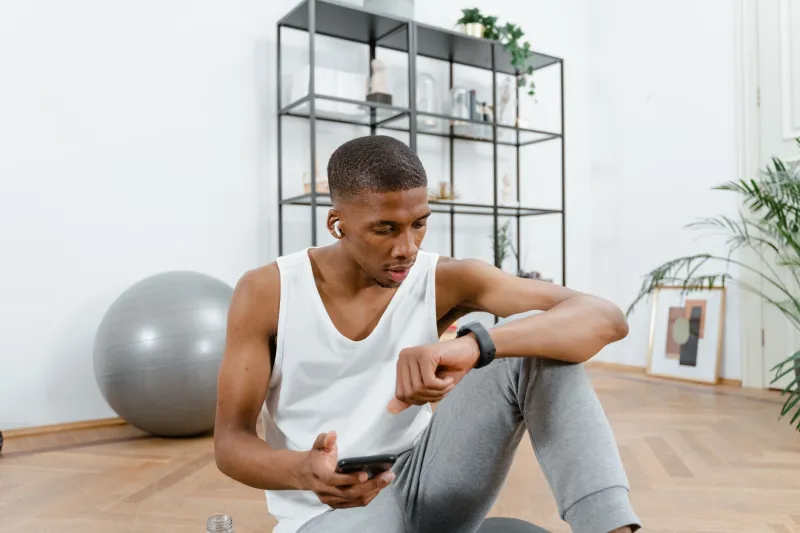
You strapped it on with good intentions. Track your heart rate. Log your steps. Monitor your sleep. Maybe even flex a little on the Strava leaderboard. Smartwatches and fitness trackers have become as standard a part of gym culture as chalk and pre-workout — and the market backs that up. Tens of millions of Americans are wearing these things every day, including every rep, every sprint, every rest period.
But here's a question worth sitting with: is all that data actually making you better? Or is it quietly messing with your head in ways you haven't noticed yet?
For a lot of people — especially those who care about performing well and showing up with confidence — the answer is more complicated than the device's marketing would have you believe.
The Data Addiction Loop Nobody Talks About
Fitness trackers are built on a feedback loop. You do something physical, the device registers it, you feel a hit of satisfaction (or anxiety), and you adjust your behavior accordingly. That loop isn't inherently bad — it's basically operant conditioning, and it works.
The problem starts when the data becomes the point.
Instead of training because it feels powerful or because you're chasing a specific performance goal, you start training for the numbers. You push harder on a day your body is begging for recovery because your weekly active minutes are lagging. You cut a session short — or worse, avoid the gym entirely — because your readiness score is low and you've convinced yourself the data says you shouldn't bother.
Psychologists call this "metric fixation," and it's a real phenomenon. When we over-index on measurable outputs, we lose touch with the qualitative experience of movement — the feel of a clean deadlift, the mental release of a hard run, the simple fact that you showed up. That disconnect has a cost, and it often shows up as reduced motivation, increased anxiety around workouts, and a fragile sense of fitness identity that collapses the moment the numbers look bad.
When Public Data Becomes a Comparison Trap
Now layer in social features — shared activity rings, group challenges, public leaderboards — and things get even messier.
America loves a good competition, and fitness apps know it. Features that let you compare your stats to friends, coworkers, or strangers are designed to keep you engaged. And they do. But engagement isn't the same as confidence, and it's definitely not the same as a healthy relationship with your body.
Research consistently shows that upward social comparison — measuring yourself against someone who's outperforming you — tanks motivation for most people. You log a solid five-mile run and feel great, then open the app and see your buddy crushed eight miles at a faster pace. Suddenly your win doesn't feel like a win anymore. You didn't get worse. The run didn't change. But your perception of it did, and that matters enormously when you're trying to build the kind of gym confidence that actually sticks.
For people already navigating body image sensitivities, this comparison spiral can be genuinely damaging. The gym should be one of the places where you feel in your body, not judged by it. A device that constantly quantifies and ranks your performance can undermine that in subtle but persistent ways.
The Readiness Score Problem
One of the more insidious features of modern fitness wearables is the daily readiness or recovery score. It sounds great in theory: your watch analyzes your HRV, sleep data, and resting heart rate, then tells you whether you're primed to train hard or should dial it back.
The issue? Most of us don't use that information neutrally. We use it as permission — or as a verdict.
A high score and suddenly you feel invincible, even if your body actually feels flat. A low score and you're second-guessing whether to even bother going to the gym, even when a moderate session might be exactly what you need. You've outsourced your body awareness to an algorithm, and that algorithm doesn't know that you slept poorly because you were excited about something, or that your HRV dipped because of a glass of wine — not because your body is breaking down.
Athletes who develop strong interoceptive awareness — the ability to accurately read their own physical and emotional states — consistently outperform those who rely heavily on external data. Your watch can be a useful tool. It shouldn't be your coach, your therapist, or your mirror.
Disconnecting Strategically (Without Going Full Luddite)
Nobody's saying throw the thing in a drawer. If your smartwatch helps you stay consistent, tracks meaningful trends over time, or keeps you accountable on days when motivation is low, that's real value. The goal isn't to reject the technology — it's to use it on your terms.
Here are a few ways to reset your relationship with wearable tech without going cold turkey:
Try at least one session a week fully unplugged. No watch, no metrics, no app. Just you and the work. Pay attention to how the session feels rather than what it produces. You might be surprised how freeing it is — and how much more present you are.
Turn off social sharing features. Seriously. Unless you're genuinely motivated (not pressured) by group challenges, the comparison element is adding noise, not signal. Your progress is yours. Protect it.
Use weekly trends, not daily scores, as your guide. One bad readiness score means almost nothing. A pattern over two or three weeks tells you something worth acting on. Train your brain to zoom out.
Set intention before you look at the data. Before you check your stats post-workout, ask yourself how you think it went. Build the habit of forming your own assessment first, then let the data inform — not override — that perception.
Style and Confidence Are Internal First
Here at StyleGyms, we talk a lot about the intersection of how you look and how you perform. But the through-line in all of it is this: confidence has to be built from the inside out. The right gear helps. A great gym environment helps. Smart training helps. But none of it lands if your internal narrative is being hijacked by a constant stream of data telling you that you're not enough.
Your smartwatch is a tool. A good one, when used well. But the most stylish thing you can do in the gym — the move that actually separates people who thrive from people who just grind — is learning to trust yourself more than your metrics.
Wear the watch. Read the data. Then set your wrist down and train like you mean it.