Why You Look Jacked at Your Gym (But Average Everywhere Else)

The Mirror That Lies (In the Best and Worst Ways)
You know the feeling. You're mid-set, you glance up at the mirror, and your arms look massive. Your posture looks locked in. Your physique looks like all those early mornings actually paid off. Then you hit a different gym — traveling for work, maybe, or tagging along with a buddy — and suddenly you look... flat. Softer. Like you skipped the last six weeks.
Same body. Different gym. Completely different reflection.
This isn't a confidence issue. It's an architecture issue. And once you understand how gym environments are engineered to make you feel a certain way, you'll never look at a mirror rack the same again.
Lighting Is the Unsung MVP of Gym Design
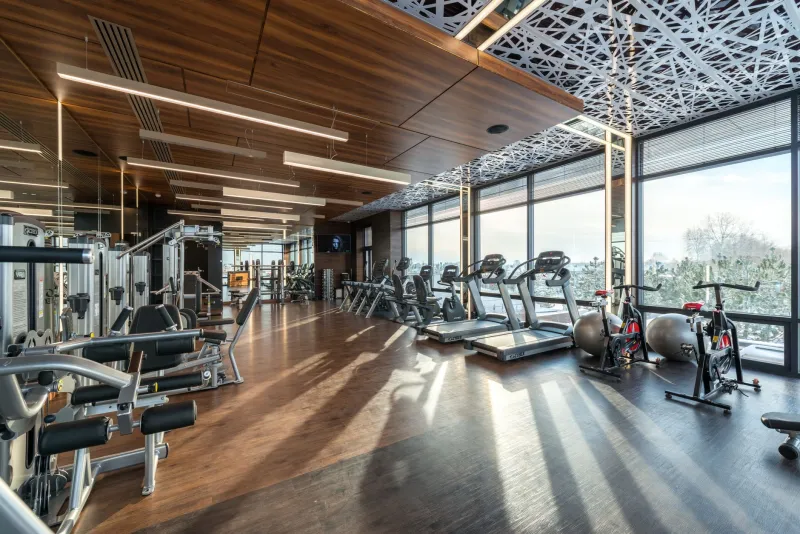
Let's start with the biggest variable: lighting. Most commercial gyms don't use the same overhead fluorescents you'd find in a hospital or a CVS. They're deliberately choosing light sources and placements that make muscles pop.
Overhead lighting positioned directly above the weight floor casts what designers call "dramatic shadows" across the body. Those shadows fall into the valleys between muscle groups — the space between your pecs, along your obliques, across your deltoids — and create the appearance of greater muscle definition than flat, diffuse lighting would ever produce.
Warm-toned lighting (think amber or soft white, in the 2700–3000K range) adds a golden hue to skin tone that reads as lean and athletic. Cool, harsh lighting does the opposite. It washes you out and flattens your features. That hotel gym with the buzzing fluorescent tube overhead? That's why you looked like you hadn't slept in a week.
High-end gym chains have figured this out. Boutique studios especially — the kind with $40 cycling classes and curated playlists — invest heavily in lighting design because they know how you feel about your appearance directly impacts whether you renew your membership.
Mirror Angles: The Subtle Tilt You've Never Noticed
Here's something wild: a mirror tilted even two or three degrees backward — top leaning slightly away from you — makes your body appear taller and leaner. It's a simple optical trick rooted in basic geometry and how the human eye processes reflected vertical lines.
Many gyms, particularly those marketing toward a style-conscious clientele, angle their mirrors this way intentionally. It's not exactly deceptive — it's more like good retail psychology applied to fitness. The same principle has been used in clothing store fitting rooms for decades.
A mirror mounted perfectly flush and vertical is actually the minority in well-designed commercial gyms. Next time you're somewhere that makes you look particularly good, crouch down and check the bottom of the mirror frame. There's a solid chance it's not sitting flat against the wall.
The inverse is also true. A mirror that leans slightly toward you at the top will make you look shorter and wider. Some older gyms — especially bare-bones warehouse-style boxes — have mirrors that weren't installed with any intentionality at all, and the results show.
Wall Color and Spatial Psychology
Color theory isn't just for interior designers and brand consultants. It plays a real role in how your brain interprets what it sees in a gym environment.
Dark walls — deep charcoal, navy, matte black — create a sense of visual contrast that makes lighter-colored clothing and skin tones stand out more sharply. That contrast reads as definition. You look more athletic against a dark backdrop the same way a product looks more premium in dark packaging.
Bright white walls do the opposite. Without contrast, your body blends into the background more easily, reducing the perceived sharpness of your physique.
Beyond color, the size of the space matters enormously. A smaller, more intimate weight floor makes you look proportionally larger. A massive open-concept gym with 30-foot ceilings and rows of equipment stretching into the distance? You're going to look like a smaller piece of the puzzle, no matter how solid your build is.
Boutique gyms figured this out early. Smaller footprints, darker tones, and strategic mirror placement aren't just aesthetic choices — they're psychological tools.
So Is Your Gym Gaslighting You?
Here's the honest question you've been building toward: if your gym makes you look better than you actually are, is that a problem?
The answer is more nuanced than a simple yes or no.
On one hand, looking good in the mirror is genuinely motivating. Research on self-efficacy — your belief in your own ability to perform and improve — shows that positive self-perception during training can increase effort, persistence, and overall performance output. If flattering mirrors and warm lighting make you push harder, that's a real, measurable benefit.
On the other hand, if your entire sense of progress is anchored to how you look in that specific gym, you might be building confidence on a foundation that doesn't travel well. The moment you step into a different environment and the reflection doesn't match your internal image, it can create a jarring disconnect that tanks motivation.
The goal is to use your gym's environment as a tool, not a crutch.
What to Actually Look For When Choosing a Gym
If you're shopping for a new gym — or reconsidering your current one — here's how to apply this practically:
Check the lighting before you sign anything. Spend five minutes in front of the mirrors during a tour. Does the lighting make you feel energized and capable? That matters. A gym that makes you dread your own reflection is a gym you'll find excuses to skip.
Notice how the mirrors are mounted. A well-maintained gym that cares about the details of its environment — mirror angles included — is usually also a gym that cares about equipment upkeep, cleanliness, and staff quality.
Don't let flattery override function. A gorgeous boutique gym with perfect lighting but no squat racks and a 45-minute waitlist for the cable machine isn't serving your actual training needs. Style and substance need to coexist.
Develop a body-neutral check-in practice. Performance metrics — weights lifted, reps completed, recovery time, endurance benchmarks — don't change based on what gym you're standing in. Build your progress narrative around those numbers, and the mirror becomes a bonus rather than the scoreboard.
The Takeaway
Your gym's mirrors aren't neutral. The lighting, the angles, the wall colors, the spatial layout — they're all working together (intentionally or not) to shape how you see yourself every time you train. The best gyms are the ones that use those elements to serve your motivation without replacing the real work.
Train in a space that makes you feel capable. Just make sure you also know the difference between looking good and being good — because only one of those follows you out the door.