Why the Lights at Your Gym Are Messing With Your Head More Than Your Muscles Are
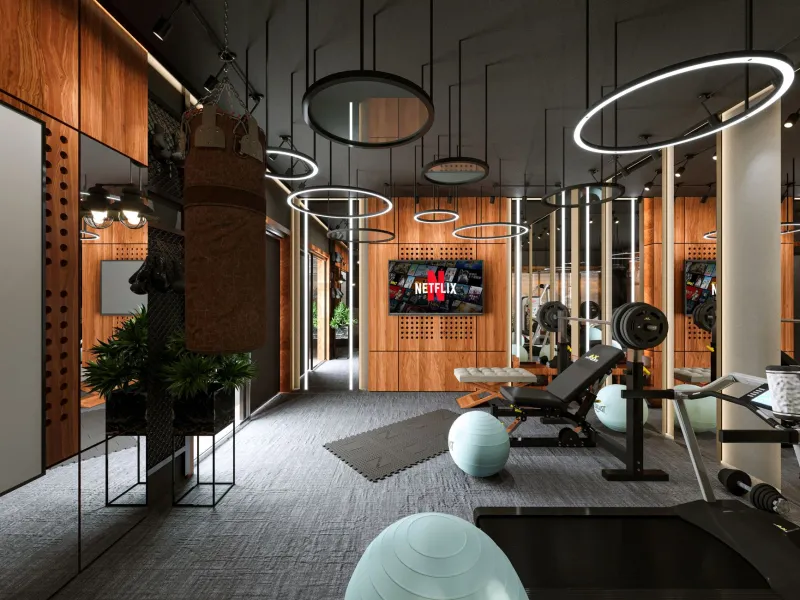
You've probably noticed it before — you look noticeably better in one gym's mirrors than another's. You feel more pumped, more defined, more motivated. Then you walk into a different facility under different lighting and wonder if you've somehow lost muscle overnight. You haven't. The lights changed.
Gym lighting is one of the most underexamined elements of the training environment, and it has a measurably significant effect on both your self-perception and your actual workout performance. This isn't a minor aesthetic quirk. It's applied environmental psychology, and fitness facility designers know it better than most members ever will.
The Color Temperature Game
Light is measured in Kelvin (K), and the color temperature of that light changes everything about how a space feels and how your body appears within it.
Warm light — in the 2700K to 3000K range — casts a golden, amber tone. It's flattering, softening, and typically found in spas, yoga studios, and boutique recovery-focused spaces. It makes skin look healthier and bodies look more dimensional, but it also signals psychological relaxation. Your nervous system reads warm light as "wind down" — which is great for a stretch class, not ideal for a max-effort deadlift session.
Cool light — in the 5000K to 6500K range — is where most high-performance gyms live. It mimics daylight, enhances contrast, and creates sharper visual definition on muscles. Under cool, bright LEDs, you'll see more shadow and separation in your physique, which can be genuinely motivating. Research published in environmental psychology journals suggests that higher color temperatures increase alertness and physical arousal — measurable effects on heart rate and perceived exertion that translate to harder training.
The sweet spot for performance-oriented training appears to be around 5000K to 5500K: bright enough to stimulate, cool enough to sharpen, without crossing into the harsh blue-white territory that causes visual fatigue during long sessions.
What Fluorescents Are Actually Doing to You
Older gyms — and plenty of budget facilities across the US — still run on fluorescent lighting, and it's not just an aesthetic issue. Fluorescents flicker at a frequency that's imperceptible to the conscious eye but registered by the brain. Over a 60- to 90-minute training session, that subliminal flicker contributes to cumulative cognitive fatigue, reducing focus and reaction time.
Fluorescents also render color poorly, making skin look flat or slightly green-tinted and reducing the visible muscle definition that motivates many gym-goers. If you've ever felt inexplicably drained at one gym but energized at another with seemingly similar equipment, lighting is a plausible culprit.
Modern LED systems don't flicker in the same way, and high-quality LEDs have significantly better color rendering — meaning the colors you see, including your own skin and muscle tone, look more accurate and more vivid. That visual feedback loop matters more than most people admit.
The Designer's Playbook
Gym designers and fitness facility consultants think about lighting with deliberate strategic intent. A well-designed gym uses different lighting zones for different functional areas — brighter, cooler light over the free weights and performance floor to drive intensity; warmer, dimmer lighting in stretching and recovery areas to signal the appropriate physiological state.
Boutique studios have taken this furthest. Many cycling and HIIT studios use dynamic lighting that shifts color temperature and brightness in sync with workout phases — warmer during warm-up, intensifying to cool bright white at peak effort, then softening again for cooldown. It sounds gimmicky, but the effect on perceived effort and session enjoyment is measurably real. Participants in dynamically lit fitness environments report higher satisfaction and, in some studies, achieve slightly higher average effort levels than those in static lighting.
What this means for you as a member: the gym that makes you feel best about your physique and most motivated to push hard isn't necessarily the one with the best equipment. It might simply be the one that figured out lighting.
The Mirror Effect Multiplier
Lighting and mirrors work as a system, not independently. The angle and intensity of light relative to mirror placement determines what you actually see when you check your form — or, let's be honest, check yourself out between sets.
Direct overhead lighting with mirrors at a slight downward angle creates the most flattering, muscle-defining view — shadows fall in ways that accentuate definition. Side lighting with flat mirrors tends to flatten and widen, which can deflate motivation even when your training is progressing well.
This is why the same physique can look dramatically different across facilities. You haven't changed. The light geometry has.
Training Effectively Regardless of the Lighting
Knowing all this, how do you train effectively in any environment — including the fluorescent-lit budget gym that's closest to your apartment?
Anchor your motivation internally, not visually. If your drive to push hard depends on looking jacked in the mirror, you're at the mercy of whatever lighting the facility chose. Build a pre-workout mental routine — a playlist, a focus cue, a specific warm-up sequence — that doesn't require visual feedback to activate.
Use your phone's camera as a neutral reference. Your phone camera renders light more consistently than your eye does in changing environments. If you're trying to track visual progress, photograph yourself in the same location, with the same lighting, at the same time of day. Don't use the gym mirror under flattering LEDs as your benchmark.
Advocate for your facility. If you're a member somewhere that still runs on aging fluorescents, it's worth mentioning to management. LED retrofits have come down dramatically in cost, and many gym operators don't realize how significantly the upgrade affects member experience and retention.
Choose your gym with lighting awareness. Next time you're evaluating a new facility, look up. The lighting system tells you a lot about how much thought went into the member experience — and how your training sessions there are likely to feel.
The gym environment is a tool, and lighting is one of its most powerful — and most overlooked — levers. Understanding it doesn't make you vain. It makes you smarter about the conditions that help you train at your best.